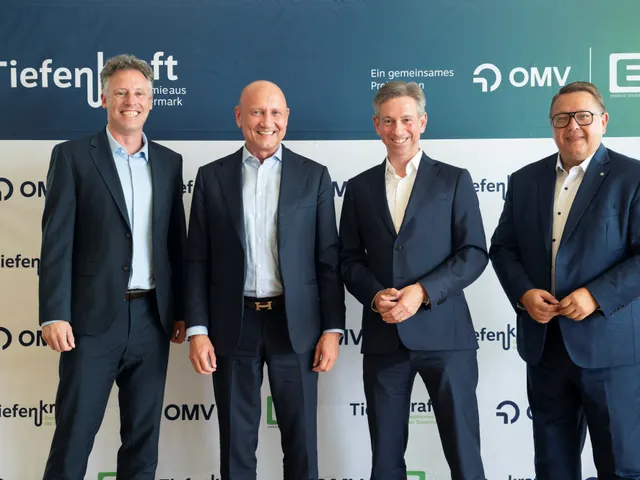
OMV and Energie Steiermark Join Forces in Deep Geothermal Energy
OMV and Energie Steiermark have joined forces to accelerate the development of deep geothermal energy in Styria, supporting the region's transition to sustainable heating solutions. During a joint event, the two companies introduced "Tiefenkraft," a collaborative initiative aimed at evaluating Styria's geothermal potential. If successfully developed, the project could generate up to 670 GWh of geothermal energy annually by 2037, enough to supply around half of the district heating demand in the greater Graz area.
As part of the initiative, a seismic survey was conducted between February and April 2026 along approximately 900 kilometers of designated road-based measurement lines. The collected data is now being analyzed and will be used to develop a detailed subsurface model, providing the foundation for future exploration and the next phases of the project.
Berislav Gašo, OMV Executive Vice President Energy, said: “Harnessing geothermal energy is key to an independent and climate-neutral heat supply in Austria. With our expertise in geology, drilling technology, and project development, we are making a vital contribution to a joint assessment of the region’s geothermal potential with Energie Steiermark and helping lay the foundation for a sustainable heat supply.”
Following the successful completion of its seismic survey, the "Tiefenkraft" project, a joint initiative by OMV and Energie Steiermark, is moving into its next phase with the planned drilling of the Petersdorf 2 exploration well in St. Marein near Graz. Drilling is expected to commence in the fourth quarter of 2026, subject to regulatory approvals and the completion of site preparations.
Preparatory work is scheduled to begin in September 2026, while the drilling and testing program is anticipated to last approximately three to four months. The exploration will provide valuable data on the region's geothermal resources and geological conditions, helping determine the project's future development.
If the exploration delivers positive results, the partners plan to proceed with the development of an initial geothermal doublet consisting of one production well and one injection well, alongside comprehensive testing. Two additional wells are also being considered to evaluate the feasibility of an Aquifer Thermal Energy Storage (ATES) system, which would enable excess heat to be stored underground for seasonal use.
At the same time, planning for a pipeline connection to Graz will continue. Energie Steiermark will contribute its expertise in infrastructure development, system integration, and heat distribution, including responsibility for the construction and operation of an approximately 20-kilometer water pipeline. This infrastructure will play a critical role in integrating geothermal energy into the region's district heating network.
A final investment decision on the full-scale development—including production and injection wells, the pipeline connection to the district heating system, and surface facilities such as a pumping station—will be made after all testing has been completed and evaluated.
The project is expected to take several years to complete, with the first geothermal heat potentially being delivered to consumers as early as 2030.
Martin Graf and Werner Ressi, members of the Management Board of Energie Steiermark, said: “With ‘Tiefenkraft’, together with OMV we are taking a decisive and forward-looking step for the heat supply in Styria. This project represents the largest single investment in the history of Energie Steiermark and combines the expertise of two strong partners across the entire value chain. Deep geothermal energy is a key building block of the heat transition and will enable a significant share of Graz’s district heating to be supplied in a climate-friendly and regional way in the future.”
The "Tiefenkraft" project combines the complementary expertise of OMV and Energie Steiermark to advance geothermal energy development in Styria. OMV contributes its extensive experience in geology, drilling, and subsurface as well as surface project development, while Energie Steiermark provides its strengths in regional energy infrastructure and system integration. Together, the partners cover the entire geothermal value chain, from resource exploration to integration into the regional energy network.
The partnership operates under a clearly defined industrial framework with distinct responsibilities. Project implementation is managed through a joint development company in which OMV holds a 75% stake and Energie Steiermark owns the remaining 25%. Meanwhile, Energie Steiermark is solely responsible for the construction of the transmission pipeline, representing an investment of approximately EUR 150 million.